




On this page:
Overview
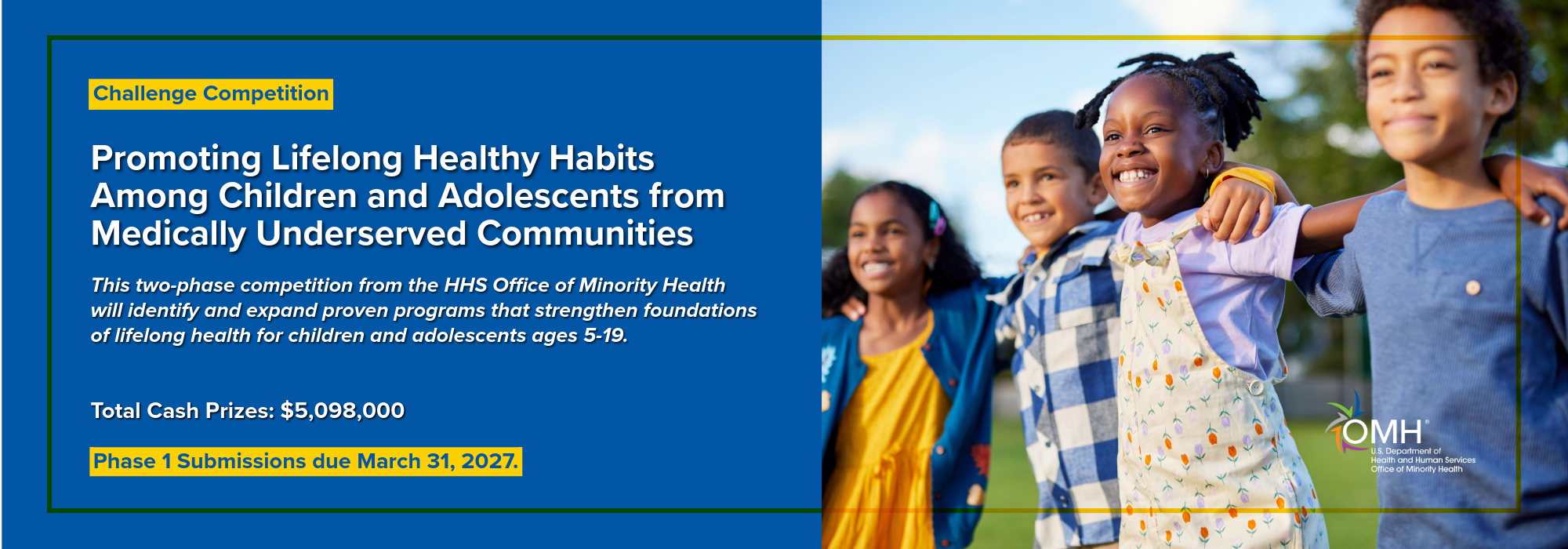
This Challenge Competition seeks to identify solutions that address the growing health challenges facing children and adolescents (ages 5-19) from medically underserved communities.1 Rising rates of childhood obesity, chronic disease, poor mental health, and excessive screen use reveal the need to form stronger foundations for lifelong health which include nutritious diets, regular physical activity, character education, time outdoors, friendship, and healthy habits.
Through this Challenge Competition, the HHS Office of Minority Health (OMH) aims to identify and elevate programs that improve health outcomes by promoting nutrition, functional physical fitness, character education, and time outdoors. Solutions should demonstrate the potential to improve the health and wellbeing of medically underserved children and adolescents.
Phase 1: OMH will award prizes to challenge Participant/Solvers that operate programs that have demonstrated success in improving the health and wellbeing of children and adolescents by promoting strong foundations for lifelong health, including nutrition, functional physical fitness, time outdoors, character education, opportunities for friendship and camaraderie, and the adoption of healthy habits and life skills that support resilience and overall wellbeing. Participant/Solvers must describe their program models, outcomes, and implementation history, and provide quantitative and qualitative outcome reports (as appropriate) in their Challenge submissions. Participant/Solvers must also describe their plans to adapt and implement their programs within one or more medically underserved communities. Participant/Solvers must include a comprehensive implementation plan informed by the population(s) of interest, along with practices, expected outcomes, evaluation strategies, partnerships, and a plan for sustainability.
Phase 2: OMH will award prizes to Phase 1 winners that have successfully expanded and/or replicated the proposed programs to improve the health and wellbeing of children and adolescents from medically underserved communities by promoting strong foundations for lifelong health, including good nutrition, functional physical fitness, time outdoors, character education, opportunities for friendship and camaraderie, and the adoption of healthy habits and life skills. Program success should be supported by measurable improvements in the health and well-being of children and adolescents from medically underserved communities backed by quantitative and/or qualitative data, as appropriate. Submissions should describe implementation results, Participant/Solver reach and engagement, lessons learned, evaluation findings, partnership outcomes, and plans to expand or replicate the program at a larger geographic scale.
The prize competition excludes the use of pharmaceutical products and surgical interventions to directly influence the obesity levels and/or health of children and adolescents from medically underserved communities.
Key Dates
Phase 1: Identification of Proven Solutions and Implementation Readiness
Submission period begins: September 29, 2026, at 11:59 PM ET
Submission period ends: March 31, 2027, at 11:59 PM ET
Phase 2: Successful Expansion and Replication in Medically Underserved Communities
Submission period begins: April 30, 2028, at 11:59 ET
Submission period ends: September 30, 2028, at 11:59 PM ET
A pre-recorded Informational Webinar will be available in October on the HHS OMH website: https://minorityhealth.hhs.gov/
For more information email us at minorityhealthinfo@hhs.gov
Prizes
| Phase | No. of Winners | Total Phase Funding |
|---|---|---|
| Phase 1 | Up to 6 | $1,529,400 |
| Phase 2 | Up to 3 | $3,568,599 |
HHS Prize Funds
HHS may award up to a total cash prize pool of $5,098,000 to the Challenge winner(s) from its FY2026 appropriations.
For Phase 1, HHS may select up to 6 submissions to each receive $254,900.
For Phase 2, HHS may select up to 3 submissions to each receive $1,189,533.
If any additional money remains in the total HHS cash prize pool, HHS may increase the prize(s) awarded in each phase by an equal share of the remaining HHS cash prize pool.
Use of Cash Prizes
Cash prizes (not grants or contracts) may be awarded under this Challenge announcement. HHS does not limit how winners may use prize money awarded to them. Therefore, winners may use prize money from one phase of this Challenge toward submissions for future phases, but they are not required to do so.
Detailed Description
Children and adolescents thrive when they have access to nutritious foods, regular physical activity, time outdoors and away from screens, supportive families, positive peer relationships, and opportunities to develop healthy habits and strong character. These foundational influences promote lifelong wellbeing while reducing the risk of poor physical and mental health conditions later in life.
As these influences have declined, health outcomes have worsened. Childhood obesity remains a major public health challenge in the United States. Recent data indicate that 21.1 percent of U.S. children and adolescents have obesity and 7.0 percent have severe obesity. The Make America Healthy Again (MAHA) Report notes that obesity among children and adolescents ages 5–19 has increased steadily over recent decades, and that the United States has the highest prevalence of obesity in this age group among G7 nations. Beyond obesity, approximately one in five U.S. children has a chronic health condition, including asthma, diabetes, mental health disorders, or other conditions requiring ongoing care. Excessive screen use has also become increasingly common, with adolescents spending an average of more than eight hours per day on screen media, a trend the Surgeon General has linked to poorer mental health, disrupted sleep, reduced physical activity, and other adverse health outcomes.
These trends threaten the health, wellbeing, strength, readiness, and future prosperity of our Nation. While influenced by many factors, they are closely associated with poor nutrition, physical inactivity, sedentary behavior, excessive screen time, social isolation, and limited opportunities for healthy recreation. Conversely, nutritious diets, regular physical activity, time outdoors, family relationships, good friendships, mentorship, character education, and healthy life habits help young people build the knowledge, skills, self-discipline, and resilience needed to flourish throughout life. Through this Challenge Competition, OMH seeks to identify and elevate approaches that strengthen these foundations of health and improve health outcomes for children and adolescents from medically underserved communities.
The populations of interest are children and adolescents from medically underserved communities.
Legal Authority
This Challenge is authorized by the America Creating Opportunities to Meaningfully Promote Excellence in Technology, Education, and Science (COMPETES) Reauthorization Act of 2010, as amended (15 U.S.C. § 3719), which authorizes Federal agencies to conduct prize competitions to stimulate innovation and advance their statutory missions.
This Challenge is also consistent with the statutory authorities of the Office of Minority Health (OMH) under Section 1707 of the Public Health Service Act (42 U.S.C. § 300u-6). Under this authority, OMH is charged with improving minority health and health care through leadership, coordination, technical assistance, information dissemination, education, and support for activities that improve health outcomes and reduce health disparities.
Consistent with these authorities, this Challenge seeks to identify, recognize, and elevate evidence-based programs that improve the health and well-being of children and adolescents from medically underserved communities by promoting nutrition, physical fitness, healthy habits, time outdoors, positive youth development, and other foundations of lifelong health. By recognizing successful and scalable approaches, the Challenge advances OMH's mission to improve health outcomes and promote effective practices.
Rules
Eligibility Rules
- To be eligible to win a prize under this Challenge, a Participant/Solver (whether an individual, team, or entity) —
- Shall have registered to participate in the Challenge as an individual, team, or entity under the rules and instructions promulgated by HHS as published in this announcement, including but not limited to, the “Prize Payment Rules” and the “How to Enter” section of this announcement.
- Shall have complied with all the requirements set forth in this announcement;
- In the case of a private entity, shall be incorporated in and maintain a primary place of business in the United States, and in the case of an individual or team Participant/Solvers, shall be a citizen or permanent resident of the United States;
- Shall not be a Federal entity or Federal employee acting within the scope of their employment;
- Shall not be an employee of the Department of Health and Human Services (HHS, or any other component of HHS) acting in their personal capacity;
- Who is employed by a Federal agency or entity other than HHS (or any component of HHS), shall consult with an agency Ethics Official to determine whether the Federal ethics rules will limit or prohibit the acceptance of a prize under this Challenge;
- Shall not be a judge of the Challenge, or any other party involved with the design, production, execution, or distribution of the Challenge or the immediate family of such a party (i.e., spouse, parent, step-parent, child, or step-child).
- Shall be 18 years of age or older at the time of submission.
- A Participant/Solver (whether an individual, team, or entity) shall not be deemed ineligible because the Participant/Solver used Federal facilities or consulted with Federal employees during the Challenge if the facilities and employees are made available to all Participant/Solvers participating in the Challenge on an equitable basis.
Participation Rules
- Participant/Solvers (whether individuals, teams, or entities) may not use Federal funds from a grant award or cooperative agreement to develop their Challenge submissions or to fund efforts in support of their Challenge submissions unless use of such funds is consistent with the purpose, terms, and conditions of the grant award or cooperative agreement. Participant/Solvers intending to use Federal grant or cooperative agreement funds must register for and participate in the Challenge on behalf of the entity that is the awardee or recipient of the grant or cooperative agreement. If a Participant/Solver uses Federal grant or cooperative agreement funds and wins the Challenge, the prize must be treated as program income for purposes of the original grant or cooperative agreement in accordance with applicable Uniform Administrative Requirements, Cost Principles, and Audit Requirements for Federal Awards (2 CFR part 200).
- Federal contractors may not use Federal funds from a contract to develop Challenge submissions or to fund efforts in support of Challenge submissions. Costs associated with such activities are unallowable and are not allocable to Government contracts.
- By participating in this Challenge, each Participant/Solver (whether an individual, team, or entity) agrees to assume any and all risks and waive claims against the Federal government and its related entities, except in the case of willful misconduct, for any injury, death, damage, or loss of property, revenue, or profits, whether direct, indirect, or consequential, arising from participation in this Challenge, whether the injury, death, damage, or loss arises through negligence or otherwise.
- Based on the subject matter of the Challenge, the type of activities that it will possibly involve, as well as an analysis of the likelihood of any claims for death, bodily injury, property damage, or loss potentially resulting from Challenge participation, no Participant/Solver (whether an individual, team, or entity) participating in the Challenge is required to obtain liability insurance, or demonstrate financial responsibility, or agree to indemnify the Federal government against third party claims for damages arising from or related to Challenge activities in order to participate in this Challenge.
- By participating in this Challenge, each Participant/Solver (whether an individual, team, or entity) warrants that they are the sole author or owner of, or has the right to use, any copyrightable works that the submission comprises, that the works are wholly original with the Participant/Solver (or is an improved version of an existing work that the Participant/Solver has sufficient rights to use and improve), and that the submission does not infringe any copyright or any other rights of any third party of which the Participant/Solver is aware.
- By participating in this Challenge, each Participant/Solver (whether an individual, team, or entity) grants to HHS an irrevocable, paid-up, royalty-free nonexclusive worldwide license to reproduce, publish, post, link to, share, and display publicly the submission on the web or elsewhere, and a nonexclusive, nontransferable, irrevocable, paid-up license to practice, or have practiced for or on its behalf, the solution throughout the world. Each Participant/Solver will retain all other intellectual property rights in their submissions, as applicable. By participating in this Challenge, each Participant/Solver warrants that there are no legal obstacles to providing the above-referenced nonexclusive licenses of the Participant/Solvers rights to the Federal government. To receive an award, Participant/Solvers will not be required to transfer their intellectual property rights to HHS, but Participant/Solvers must grant to the Federal government the nonexclusive licenses recited herein. By participating in this Challenge, Participant/Solvers are not granted any licenses to use or rights in any HHS trademarks, including the HHS logo. Participant/Solvers may not imply endorsement by HHS or the Federal government. Any use of HHS trademarks by Participant/Solvers is subject to prior, written authorization by HHS and subject to any requirements of the HHS Office of the Assistant Secretary for Public Affairs (ASPA).
- Each Participant/Solver (whether an individual, team, or entity) agrees to follow all applicable Federal, state, and local laws, regulations, and policies.
- Each Participant/Solver (whether an individual, team, or entity) participating in this Challenge must comply with all rules and requirements included in this announcement, and participation in this Challenge constitutes each Participant/Solver's full and unconditional agreement to abide by the rules and requirements. Winning is contingent upon fulfilling all requirements herein.
- As a condition for receiving a cash prize in this Challenge, each Participant/Solver (whether an individual, team, or entity) that has been selected as a winner must complete and submit all required winner verification and payment documents to HHS. Failure to return all required verification and payment documents by the date specified in the formal winner notification may be a basis for disqualification of a cash prize winning submission.
- By participating in this Challenge, each Participant/Solver (whether an individual, team, or entity) agrees that HHS may disqualify its submission if, in HHS’ judgment, the submission is inconsistent with HHS’ public health mission, may be ineffective or harmful, or any other reason deemed necessary.
Prize Payment Rules
- For each eligible Participant/Solver under the “Eligibility Rules,” HHS will use that Participant/Solver's registration as an individual, team, or entity on the “HHS Challenge Participant/Solver Registration Form” to determine who receives payment of any HHS prize money.
- For an eligible winning Participant/Solver registered as an individual, HHS will pay any prize money for the individual to the individual.
- For a winning Participant/Solver registered as a team with an eligible Team Leader, HHS will pay any and all prize money for that team to the Team Leader, and division of the prize money is at the discretion of the Team Leader. HHS will not arbitrate, intervene, advise on, or resolve any matters among team members.
- For an eligible winning Participant/Solver registered as an entity, HHS will pay any prize money for the entity to the entity.
- Prizes awarded under this Challenge by HHS will be paid by electronic funds transfer and may be subject to Federal income taxes. HHS will comply with the Internal Revenue Service withholding and reporting requirements, where applicable.
- Entities participating in this Challenge are encouraged, but not required, to request and obtain a free Unique Entity ID (UEI), if they have not already done so, via SAM.gov as this may expedite prize payment. Additional information can be found at https://sam.gov/content/entity-registration.
Other Rules
HHS reserves the right, in its sole discretion, to (a) cancel, suspend, or modify the Challenge, or any part of it, for any reason, and/or (b) not award any prizes if no submissions are deemed worthy.
Judging
The HHS Award Approving Official will be CAPT Mahyar Mofidi, Deputy Assistant Secretary for Health and Director of the HHS Office of Minority Health.
A. Phase 1 (FY2027): Identification of Proven Solutions and Implementation Readiness
Phase 1 will award prizes to programs that have demonstrated success in improving the health and wellbeing of children and adolescents (ages 5-19) by promoting strong foundations for lifelong health. These foundations include good nutrition, functional physical fitness, time outdoors, character education, opportunities for friendship and camaraderie, and the adoption of healthy habits and life skills that support resilience and overall wellbeing. Participant/Solvers must describe their outcomes along with their plans to adapt and implement their program within one or more medically underserved communities.
In Challenge submissions, Participant/Solvers are expected to:
- Demonstrate measurable success at improving the health and wellbeing of children and adolescents by promoting strong foundations for lifelong health, including good nutrition, functional physical fitness, time outdoors, character education, opportunities for friendship and camaraderie, and the adoption of healthy habits and life skills that support resilience and overall wellbeing.
- Describe their existing programs, including:
- Program goals and objectives
- Target population
- Program methods
- Program and implementation history
- Participant/Solvers reach
- Evidence of program effectiveness, including health related outcomes supported by quantitative and/or qualitative data, as appropriate
- Lessons learned
- Describe plans to implement and adapt their program(s) to serve children and adolescents from one or more medically underserved communities. These plans should be informed by the population(s) of interest and must include practices, expected outcomes, and a sustainability strategy. Plans should describe the needs of the community this program intends to serve--for instance, obesity prevalence, nutritional deficiencies, or access to green spaces--contingent upon the availability of baseline data. If modifications to the existing program are required to accommodate the needs of the selected medically underserved communities, describe the proposed program modifications.
- Describe how the program will be monitored and evaluated after implementation in medically underserved communities.
- Describe intended partnerships with community-based organizations, schools, faith-based organizations, youth-serving organizations, healthcare providers, recreational organizations, and/or other partners, as appropriate.
Phase 1 Judging Criteria
Scores are weighted and aggregated to create a final score.
- Demonstrated Program Effectiveness (40 points)
Judges will consider:- Strength of evidence that the program has successfully improved the health and wellbeing of children and adolescents by promoting strong foundations for lifelong health, including good nutrition, functional physical fitness, time outdoors, character education, opportunities for friendship and camaraderie, and the adoption of healthy habits and life skills that support resilience and overall wellbeing.
- Clear, measurable improvements in health outcomes supported by quantitative and qualitative data, as appropriate. Submissions should include baseline and follow-up data, when available.
- Program Description and Organizational Experience (20 points)
Judges will consider:- Clarity and completeness of program goals, objectives, implementation history, Participant/Solver reach, outcome data, and lessons learned.
- Organizational experience and capacity serving children and adolescents.
- Evidence that the organization has sufficient experience and capacity to deliver the program effectively.
- Medically Underserved Communities Expansion Strategy (20 points)
Judges will consider:- Quality and feasibility of plans to serve one or more medically underserved communities.
- Demonstrated understanding of the selected community’s needs, use of demographic and baseline health data where available, evidence-based approaches, proposed adaptations/modifications, and anticipated outcomes.
- Partnerships and Community Engagement (5 points)
Judges will consider:- Strength and relevance of partnerships with schools, community-based organizations, faith-based organizations, healthcare providers, recreational organizations, youth-serving organizations, and/or other stakeholders.
- Evidence that partners will contribute meaningfully to implementation and challenge Participant/Solver engagement.
- Evaluation and Performance Measurement Plan (5 points)
Judges will consider:- Strength of the proposed evaluation approach for implementation within medically underserved communities.
- Clearly defined outcomes, metrics, data collection methods, timelines for evaluation, and plans for measuring effectiveness and continuous improvement.
- Sustainability and Long-Term Impact (10 points)
Judges will consider:- Likelihood that program benefits and services will continue beyond the period of the Challenge.
- Sustainability strategy, institutional support, funding diversification, workforce development, and/or other factors that contribute to sustainability.
B. Phase 2 (FY2028): Successful Expansion and/or Replication in Medically Underserved Communities
Phase 2 will award prizes to programs that have successfully implemented their proposed interventions to improve the health and wellbeing of children and adolescents (ages 5-19, identified in Phase 1) from one or more medically underserved communities by promoting strong foundations for lifelong health, including good nutrition, functional physical fitness, time outdoors, character education, opportunities for friendship and camaraderie, and the adoption of healthy habits and life skills that support resilience and overall wellbeing.
Participant/Solvers are expected to:
- Demonstrate measurable success at improving the health and wellbeing of children and adolescents from one or more medically underserved communities by promoting strong foundations for lifelong health, including good nutrition, functional physical fitness, time outdoors, character education, opportunities for friendship and camaraderie, and the adoption of healthy habits and life skills that support resilience and overall wellbeing.
- Describe plans to expand or replicate the intervention at a larger geographic scale to increase the impact of the program. If modifications to the existing program are required to accommodate expansion or replication, describe the proposed program modifications.
- Describe outcomes of partnerships with community-based organizations, schools, faith-based organizations, youth-serving organizations, healthcare providers, recreational organizations, and/or other partners, as appropriate. If additional partnerships are required to scale the program, describe additional intended partnerships.
Phase 2 Judging Criteria
- Program Implementation, Operational Excellence, and Demonstrated Success in Medically Underserved Communities (60 points)
Judges will consider:- Strength of evidence that the intervention successfully improved the health and wellbeing of children and adolescents from medically underserved communities by promoting strong foundations for lifelong health, including good nutrition, functional physical fitness, time outdoors, character education, opportunities for friendship and camaraderie, and the adoption of healthy habits and life skills that support resilience and overall wellbeing.
- Measurable improvements in health outcomes, supported by quantitative and qualitative evidence, as appropriate. Submissions should include baseline and follow-up data, when available.
- Quality of implementation during Phase 1, including adherence to program design, child and adolescent engagement, operational effectiveness, reach, retention, lessons learned, and responsiveness to challenges.
- Evidence that the program has successfully delivered results for the intended population(s).
- Adherence to ethical principles when working with children and adolescents, data collection methods, monitoring processes, and plans to assess effectiveness, child and adolescent retention in the program, and continuous improvement during expansion.
- Expansion and Replication Strategy (25 points)
Judges will consider:- Strength and feasibility of plans to expand or replicate the intervention to a broader medically-underserved geographic area or additional medically-underserved communities.
- Clear rationale for expansion, identification of target communities, anticipated reach and impact, scalability of the model, and any proposed modifications necessary to support successful expansion.
- Partnership Outcomes and Future Collaboration (5 points)
Judges will consider:- Evidence that partnerships contributed meaningfully to Phase 1 implementation and outcomes.
- Strength of existing collaborations and plans to establish additional partnerships needed for successful expansion.
- Sustainability and Long-Term Impact (10 points)
Judges will consider:- Likelihood that program benefits and operations will continue and grow beyond the Phase 2 award.
- Leadership, organizational capacity, resources, institutional support, sustainability strategy, and potential for long-term impact in child and adolescent health.
How to Enter
To enter this Challenge, Participants/Solvers must:
- Register by emailing one signed PDF of the "HHS Challenge Participant/Solver Registration Form" per submission to minorityhealthinfo@hhs.gov and
- Please use “Registration for OMH Healthy Habits Challenge” as your email subject line.
- Email your challenge submission to minorityhealthinfo@hhs.gov.
Additional Information Regarding Registration
Registration is required to be eligible to win a cash prize. When you register using the “HHS Challenge Participant/Solver Registration Form,” you will need to decide whether you are registering as:
- An individual (on behalf of yourself);
- A team (on behalf of a group of people competing together, but not on behalf of an established organization, institution, or corporation). If registering as a team, each participating team is required to designate an eligible Team Leader who will register and submit on behalf of the team members. The Team Leader is responsible for all communications with HHS; or
- An entity (on behalf of a legally established organization, institution, or corporation).
Your decision to register as an individual, team, or entity on the “HHS Challenge Participant/Solver Registration Form” will determine who HHS pays any prize money from this Challenge. Please see “Prize Payment Rules” in the “Rules” section. Before registering, you may wish to consider any potential tax consequences of registering as an individual, team, or entity.
The “HHS Challenge Participant/Solver Registration Form” is available under the “Resources” section for this Challenge.
HHS reserves the right, in its sole discretion, to grant or deny any request to update registration information on the “HHS Challenge Participant/Solver Registration Form.”
Additional Information Regarding Submission Requirements
- Submissions must be submitted as a single PDF document using Arial font no smaller than 11-point.
- For detailed information regarding submission requirements, see the Judging Criteria section.
- The Phase 1 submission must not exceed ten (10) pages (excluding references) and should include the following:
- Executive Summary (approximately one paragraph) that clearly describes:
- The program;
- The target population currently served;
- How the program has previously demonstrated effectiveness through measurable outcomes supported by quantitative and/or qualitative data, as appropriate.
- Program Description, including:
- Program goals and objectives;
- Target population;
- Core activities and implementation approach;
- Organizational experience implementing the program;
- Participant/Solver reach and implementation history.
- Evidence of Program Effectiveness, including:
- Measurable improvements in child and adolescent health and wellbeing;
- Baseline and follow-up outcome data, when available;
- Quantitative and/or qualitative evidence demonstrating program success;
- Key lessons learned from implementation.
- Medically Underserved Community Expansion Plan, describing:
- One or more medically underserved communities the program proposes to serve;
- Community needs the program intends to address;
- Any proposed adaptations to the existing program;
- Expected outcomes following implementation.
- Evaluation and Sustainability Plan, including:
- Methods for monitoring implementation and measuring outcomes;
- Key performance measures and evaluation approach;
- Strategy for sustaining the program beyond the Challenge period.
- Partnership Strategy, describing existing and/or planned partnerships with schools, community-based organizations, faith-based organizations, healthcare providers, recreational organizations, youth-serving organizations, or other partners that will support successful implementation.
- Executive Summary (approximately one paragraph) that clearly describes:
- The Phase 2 submission must not exceed fifteen (15) pages (excluding references) and should include the following:
- Executive Summary (approximately one paragraph) that clearly describes:
- The intervention implemented during Phase 1;
- The medically underserved population(s) served;
- The program's demonstrated impact on the health and wellbeing of participating children and adolescents, supported by measurable outcomes.
- Program Implementation and Results, including:
- A description of how the Phase 1 implementation plan was executed;
- Participant/Solver reach, recruitment, retention, and engagement;
- Operational successes and challenges;
- Lessons learned during implementation.
- Evidence of Program Impact, including:
- Measurable improvements in the health and wellbeing of children and adolescents from one or more medically underserved communities;
- Baseline and follow-up outcome data, when available;
- Quantitative and/or qualitative evidence demonstrating program effectiveness;
- Evidence that the intervention was successfully delivered within the intended population(s).
- Expansion and Replication Strategy, describing:
- Plans to expand or replicate the intervention to a broader medically-underserved geographic area or additional medically-underserved communities;
- Target populations and anticipated reach;
- Any proposed modifications needed to support successful expansion;
- Expected public health impact of the expanded program.
- Evaluation and Continuous Improvement, including:
- Methods used to monitor implementation and evaluate outcomes;
- Performance measures, data collection methods, and evaluation findings;
- How evaluation results informed program improvements;
- Plans for ongoing monitoring during future expansion.
- Partnership Outcomes and Sustainability, describing:
- How partnerships with schools, community-based organizations, faith-based organizations, healthcare providers, recreational organizations, youth-serving organizations, and/or other partners contributed to implementation and outcomes;
- Any additional partnerships needed to support future expansion;
- The organization's strategy for sustaining and growing the program beyond the Challenge period, including organizational capacity, leadership, institutional support, and other factors contributing to long-term impact.
- Executive Summary (approximately one paragraph) that clearly describes:
Resources
HHS Challenge Participant/Solver Registration Form [PDF - 174 KB]
A pre-recorded Informational Webinar will be available in October on the HHS OMH website
For more information email us at minorityhealthinfo@hhs.gov
1 "Medically underserved communities" and "medically underserved populations" are used interchangeably in this announcement and carry the meaning given to "medically underserved population" by the Health Resources and Services Administration (HRSA) under section 330 of the Public Health Service Act. Under that provision, the term "medically underserved population" means the population of an urban or rural area designated by the Secretary as an area with a shortage of personal health services, or a population group designated by the Secretary as having a shortage of such services (42 U.S.C. § 254b(b)(3)(A)). (Back to top)
Date Last Reviewed: September 2026